The marketplace
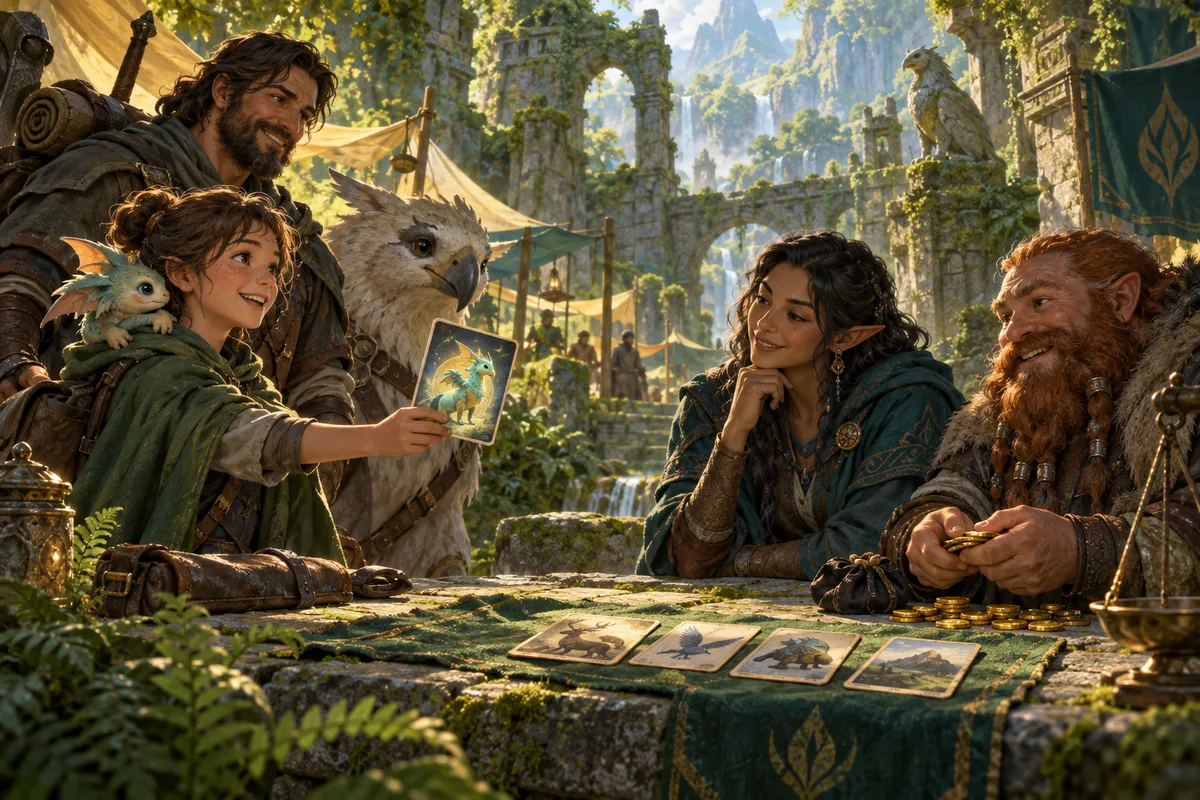
Every other mechanic in the handbook is a team against the story. This is the one where the other teams are the content: turn it on and a team can sell a card it captured to any other team on the trail, at a price it names.
A story's switch, a trail's opt-out, RPG mode only
The marketplace belongs to the story: switch it on there and every trail built from it opens with one. A host can still close theirs. It needs RPG mode, and it is off until an author asks for it.
At the venue
With the market on, the trail bar carries a Market door beside the board; with it off, nothing on the trail mentions selling.
The rule
- Off by default on every story. An author turns it on; a host can turn it off on one trail without touching the story.
- It needs RPG mode, because basic mode has coins and nothing to spend them on — a basic story with the switch on grants no market.
- One story can run twice from the same cards and the same printed sheet: trading on for the family afternoon, off for the school group.
You decide
- The story's switch, and the trail's.
From the library
The marketplace shipped for a story written for it, not as something every trail does.
List one of yours
A collectable or an ally your team captured goes on the shelf at any price from one coin up. It stays yours while it sits there, and you can take it back off at any time.

 +4
+4

A listing, as the shelf shows it. Coins go to the seller, the card and its gear go to the buyer, and neither team's score moves.
At the venue
The sell form offers the cards the shelf accepts and nothing else; a price, a tap, and the card is on the market with the team's name beside it. Cancel, and it comes off with nothing changed.
The rule
- Two kinds may be listed: collectables and allies. An enemy is a trophy, and a merchant, a checkpoint, a question, an event, a trap or a dice roll is a place the team stood, not goods.
- The price is any whole number of coins from one up to a ceiling far past any real ask.
- A listed card is still yours: your loot, your stats, your quest gates. Nothing is committed until somebody buys it.
- A quest key never lists — the shelf refuses it and the form never offers it.
You decide
- Nothing beyond the switch. What a team lists and at what price is the team's own game.
From the library
The listing above shows a real library card on the shelf at its coin value, with no button, because nothing on this page is for sale.
Buy from another team
The shelf names the card, the price and the team selling it. Buying moves your coins to them and the card to you, with its attack and defense on it — and no points to anybody.
At the venue
One Buy button per listing the purse can afford. Tap it and the coins leave, the card arrives — carried if there is room, set down if not — and the seller's purse rises by the price. Neither score moves.
The rule
- You cannot buy your own listing or a card your team already holds.
- Choose your team's role before trading on a roles trail. A purchase needs an open listing, time left for both teams, a living buyer, a card the buyer does not hold, and enough coins.
- If two teams tap Buy in the same second, one gets it and the other is told it is gone — never both.
- A resale pays no points to either side: the finder keeps the points the card scored, and the buyer gets the card and its gear.
You decide
- Nothing. The trade is between the two teams, and the engine only keeps it honest.
From the library
The Fossil Hunters above are a locale team name; the card is the library's, and the price its coins.
Or the trail is the shop
Mark a card as market stock and the trail sells it at its coin value, with no Merchant card to find first. Quest gates, role values and pack limits still apply.
At the venue
A second shelf on the market page, the trail's own: each stock card with its price and what it grants, a Buy button on each the purse can afford, and a sold-out mark once the copies are gone.
The rule
- Stock stays off the printed sheet like merchant stock — a shelf rather than a hiding place.
- Quest gates hold on the shelf: a card locked behind two finds is not for sale until they are found.
- A stock purchase banks vitality once, at your role's value. Attack and defense count while the card is carried. A resale raises the buyer's health ceiling and heals nothing.
- Copies run out. The nightly clear refills them by taking the day's rows.
- Stock pays no points. Buying is not finding, and the board only counts what a team found, answered and beat.
You decide
- Which cards are stock, at what coin value, and how many copies the party gets — the same rarity arithmetic as the printed cards.
From the library
The library's stories stock nothing by default; a card becomes stock when its author marks it.
The rules that keep the board honest
Quest items never sell. Coins move and are never made. Points never move at all. Trading moves the ceiling and checkpoints do the healing. The clock closes the shelf.
At the venue
None of this shows on a card. It shows on the board: a trail with trading on has exactly the points in play that the same trail has with it off, and no team can sell itself unconscious.
The rule
- Quest items never sell: a card that unlocks another card is refused by the shelf, so the key stays with the team that walked to it.
- Coins move, and are never made: a sale takes coins out of one purse and puts them in another. Nothing is minted.
- Points never trade: a sale moves coins and a card, and both teams' scores stay where they were. A card you sold and find again pays its coins, never its points a second time.
- Attack and defense go with the card. Health does not: a resold card raises what the buyer may carry rather than healing them on the spot, because its health was paid out once to whoever found it, and paying it again on every hand-off is how two teams would farm it.
- No team can sell itself unconscious: what a team may carry is three plus the cards it holds, so a seller's ceiling never falls below three.
- On a countdown trail, a team whose time is up can read the market and buy nothing, and its listings come off the shelf. A finished team is not paid after the whistle.
You decide
- Nothing — these hold on every trail with a market. They are what make the switch safe to flip.
From the library
The card changes hands as one record with a new owner, never as a copy, which is how the rules above hold at every second of a busy Saturday.
Teams trade on the same day
A shelf is worth something only while there is somebody there to sell to. Where the board clears each night, the market is that day's: it earns its place on a busy Saturday and does nothing for two families a week apart.
At the venue
On a trail that clears nightly, the day's listings go with the day's teams. On a race, the market lives as long as the event.
The rule
- The nightly clear purges the day's players, and their listings go with them.
- A market with one team on it is a shelf with no buyer — the mechanic is only as good as the crowd.
You decide
- Whether the trail clears nightly, and how many teams the day brings.
From the library
The demo trail clears nightly, so its market — were it on — would be each Saturday's.
Run one this month.
- Free includes every ready-made story, printable codes and the leaderboard. No card, and it never expires.
- One trail at a time, and 3 teams on its board. A team is one phone, any number of people — and your own phone takes no place.
- A place frees when you press Reset the board. Finishing a hunt frees your trail slot for the next one.
- Paid plans add stories of your own and more daily players. Automatic daily resets start at 50 players. Upload your own card art.