Coins and the shop
Points keep the score. Coins buy equipment and break a tie. Spending on a sword leaves your earned points intact.
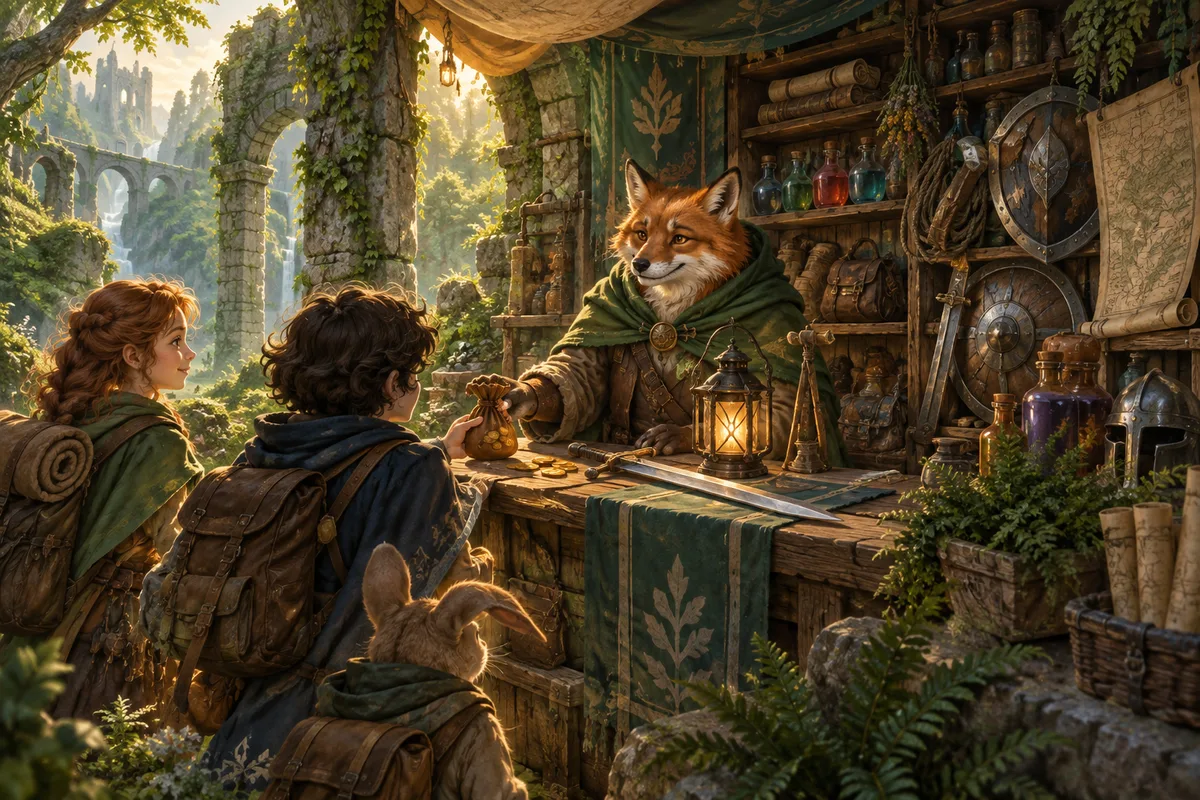

Coins: the purse you can spend
Every find, right answer, won fight and won roll pays coins in. Every purchase, wrong answer, trap, lost roll and lost fight takes coins out — and the purse never goes below zero.
| Coins come in | Coins go out |
|---|---|
| Finding a collectable, an ally or a checkpoint | Buying from a merchant or the trail's stock |
| Answering a question right | Answering a question wrong |
| Beating an enemy | Stepping around a trap, or failing to disarm it |
| Winning a dice roll | Losing a dice roll |
| The first-find bonus, on a race | Losing a duel, capped at a quarter of the purse |
| Selling a card on the marketplace |
At the venue
Your team shows score and coins separately. The shop shows your purse and each price; buying equipment keeps your earned points.
The rule
- In: a collectable, an ally or a checkpoint found; a question answered right; an enemy beaten; a dice roll won; the first-find bonus on a race; a sale on the marketplace.
- Out: a purchase; a wrong answer; a trap, stepped around or fumbled; a lost roll; a lost duel, capped at a quarter of the purse.
- A loss is always clamped to what the team holds — no purse goes negative and no card charges more than the pouch.
You decide
- Set each card’s points separately from its coin reward, shop price or hazard cost.
From the library
The demo deck's galleries pay a few coins each and its boss twenty, so the finale is worth more than the walk to it.
Points first. Coins and time break ties.
Highest score wins. At equal scores, more remaining coins wins; if both match, less playing time wins.
At the venue
The board shows each team’s points, remaining coins and playing time. A nightly clear starts a new board; a race keeps one board for the event.
The rule
- Score first, then remaining coins, then elapsed playing time. Exact ties keep a stable order.
- A team at zero points takes no percentile badge — the top 10%, 5% and 1% are handed out among teams that scored.
- Spending and losses reduce the purse, never earned points. Purchases and resales award no points.
You decide
- Point rewards set the value of discoveries and victories. Coin rewards and prices set what equipment a team can afford.
From the library
The demo trail clears its board nightly, so each day's Fossil Hunters start from zero.
The merchant is where coins go by choice
Finding the merchant opens its shelf. Each ware costs its own coin value and grants its stats; the stock is revealed at the shop and hidden nowhere.

 0
Points
0
Points
A field lab tent where preparators clean, stabilize, and study whatever the team pulls out of the ground.


Dinosaur Dig Adventure's merchant, stocked as its author stocked it. The stock never prints on the sheet.
At the venue
A scan opens the shop: every ware with its price and what it grants, a Buy button on each the purse can afford, and the coins counted at the top. Buying spends the coins and hands the card over on the spot.
The rule
- A ware is any card pointed at the merchant. It never prints on the sheet and never sits on the board — it is a shelf, not a hiding place.
- The price is the ware's own coin value, checked again when the purchase is made. No haggling, no skill game.
- A bought ware is a card owned, not a card found: it pays its stats and no points.
- A ware locked behind other cards stays locked on the shelf until they are found; finding the merchant is itself the gate on everything it sells.
- The merchant card pays nothing on its own unless its author put points on it. Its worth is the shelf.
You decide
- Which cards point at the merchant and what each costs. Stock it with the gear that makes the boss winnable and you have built a decision, not a shop.
- The playtest fails a deck whose income cannot afford its cheapest purchase and warns about one that cannot afford them all.
From the library
The library's first stocked merchant is drawn above, shelf and all, when the library holds one.
First find pays a bonus, on a race
On a race, the first team to reach a card takes a bonus nobody else can. On a self-paced trail there is no bonus, because "first" there is only whoever came on the Saturday.
At the venue
The first team to a code sees the bonus land with the card's coins; every team after it gets the card's coins alone.
The rule
- Paid once per card, to the first team that captures it, on top of the card's coins.
- A race is a trail with one starting gun and one deadline; a self-paced trail starts each team's clock on arrival and pays no bonus.
You decide
- The bonus on the trail, and whether the trail is a race at all.
From the library
The demo trail is self-paced and clears nightly, so it pays no bonus.
Three cards that ask a team to decide
A dice roll, a trap and a question each state their price before the tap and take coins only — never stats. Each has its own section on the cards chapter.
At the venue
The stakes are on the card before the button: the pot and half of it, the toll and the coin flip, the coins a wrong answer costs. Walking away from a roll keeps the purse; a trap and a question always resolve.
The rule
- Coins only. Not one of the three touches attack, defense or vitality.
- Every price is clamped to the purse, so a team with three coins risks three, however the card is priced.
- The numbers live on the cards chapter: the dice roll's four dice and five, the trap's coin flip against half, the question's wrong-answer cost.
You decide
- The coins on each card — the whole of the stake.
From the library
The library's five-year-old story gates every fight and prices its gambles in single digits.
Run one this month.
- Free includes every ready-made story, printable codes and the leaderboard. No card, and it never expires.
- One trail at a time, and 3 teams on its board. A team is one phone, any number of people — and your own phone takes no place.
- A place frees when you press Reset the board. Finishing a hunt frees your trail slot for the next one.
- Paid plans add stories of your own and more daily players. Automatic daily resets start at 50 players. Upload your own card art.