No trust falls.
A boss fight before lunch.
Teams scan the QR codes you hide around the office and race to the boss on one live leaderboard. Twenty codes, about an hour, no one on a microphone.
Your first 5 players are free, no card. Then $1 a player.
- One player = one team, one phone
- No app, no sign-up
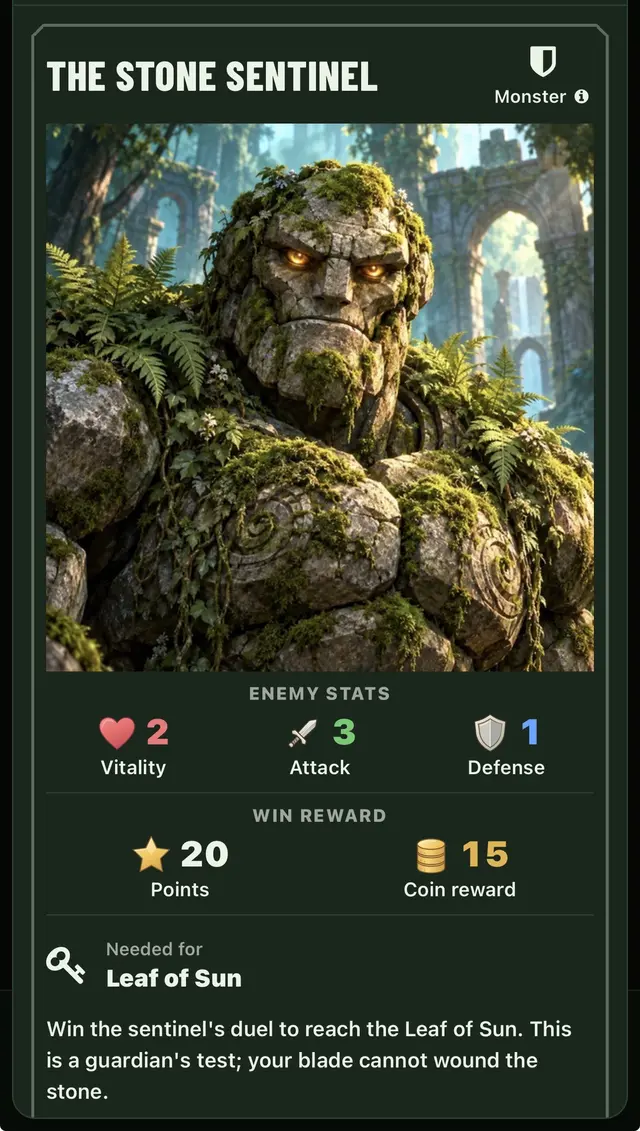
What a scan opens: a monster to duel. Win, and the Leaf of Sun unlocks.

The hour, and your part
Each code opens a card on the phone: treasure, a riddle, a merchant, a monster to fight — and a boss that stays locked until a team finds the sword.
- On the floor: by the second code, the intern is holding the phone. By the last, one team has the sword.
- Your part: pick a ready-made story — a spy mission, a pirate cove, the Odyssey. Print and cut the codes in about 10 minutes.
- What it takes: one phone per team, signal or Wi‑Fi at every code, and a printer.
Two ways to run it
The offsite
Codes across the venue, between the morning session and lunch. That slot usually holds an icebreaker nobody enjoys.
Onboarding week
A trail through the building for each group of new hires. They learn where things are by having to find them, and the next group plays the same codes on a fresh leaderboard.
What it costs
On the day
A player is a team on one phone, not a person. Forty people in teams of four play on ten phones — $10 (10 Gold Eggs). Gold Eggs come in one-off packs, no subscription.
A trail written around your office
Write your own story around the floor you actually have — the atrium, the third meeting room, the kitchen nobody uses. About 30 minutes with your AI assistant. Twenty cards: $20 (20 Gold Eggs), art included, paid once. See how a story gets written
Your first 5 players are free, no card. Then $1 a player.