A GPS scavenger hunt with nothing to print.
Each pin holds a card.
Pin each card to a spot on the map — a bench, a gate, the oldest oak. Teams walk into the circle around it, tap the pin, and the card opens in the phone's browser: treasure, a question or a monster to duel.
The first 20 phones on every board are free, no card. Then $1 a phone.
- No app, no sign-up to play
- One phone per team
- Outdoors, with signal
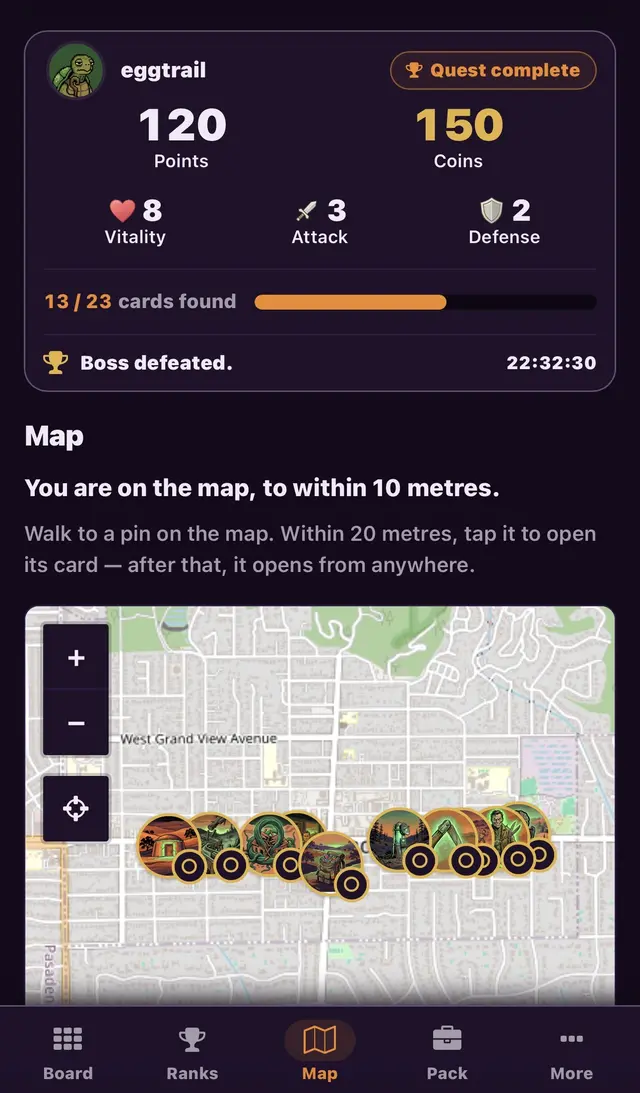
A real GPS trail on a player's phone. Its host set a 20-metre (65-foot) circle.

What a GPS scavenger hunt is
A scavenger hunt whose stops are places on a map, not codes on a wall.
Watch one written, pinned and played to the boss.
What the film shows, in words
- 0:00 A pin on a map at night, with a circle around it. Each pin holds a card. A team walks into the circle and the card rises: a Foot Soldier. In RPG mode, some of them fight back.
- 0:08 Host, paid plan. The circle becomes a window onto a town drawn line by line. The place sets the scene; you write the plot — by hand, or with your AI assistant.
- 0:19 Nine kinds of card click onto the dial: checkpoint, enemy, ally, collectable, question, dice roll, trap, event, merchant. Two to four team roles — The Gardener, The Insomniac, The Film Buff — each favour their own gear.
- 0:30 The boss, The Truck in the Triangle, is locked behind three cards: garden shears, a thermos of black coffee and a torn seed catalog. The hardware store sells weed killer for 30 coins.
- 0:41 The host picks GPS locations instead of QR codes, then drags each card onto the map or stands on the spot and pins it there. A pin dropped inside another card's circle is put back: pins stand at least one circle apart. No printer. No container. (Since filming, pins may stand close together.)
- 0:52 Moving cards: on. The host gives the boss two more spots. Some cards move between spots you pick — and answer for.
- 0:59 On the team's phone — one phone per team, no app, no sign-up — the boss's circle waits outside the map, locked. The team walks into each key's circle and each key goes to the Pack. The lock opens, and the boss moves to another spot.
- 1:05 Walk into the circle. Open the card. Every enemy is a duel — a pointer, a gap, a tap. Five hits later the team has won 100 coins and 10 points.
- 1:19 Build a trail for free. Your own stories and GPS need a paid plan. Every stop needs internet; GPS also needs location access and the outdoors. (Since filming, GPS comes with every account at no extra cost, and a story of your own is paid card by card.)
What a pin can do that a code cannot
A code stays where it is taped. A pin is a place on a map, and a place on a map can change.
-
Cards that move
Give a monster, a boss, an ally or a runaway animal a few spots and a timetable, and it walks between them. Moving cards stay off until you switch them on and confirm every spot suits your players' ages. How moving cards work
-
A boss that appears
Lock the boss behind the sword: its pin stays off the map until a team holds the sword.
-
A pin you can fix on the day
A van parked on the spot the morning you start? Drag the pin while the trail runs. A team that already reached the card keeps it.
How to set one up
The walk is the setup — one lap of your route, phone in hand.
-
Pick or write the story
Start from a ready-made story, or write your own around the place — by hand, or in about 30 minutes with the AI assistant you already use.
-
Choose GPS and the circle
When you build the trail, choose GPS instead of QR codes, and how close a team must stand — 30 metres (about 100 feet) unless you change it.
-
Pin every card
Drag each card onto the map, or stand on the spot and pin it where you are. Pin the bench, not the traffic island.
-
Walk it, then start
Walk the route with a phone and move any pin that sits wrong. Press Start and share the link — the leaderboard ranks teams from the first card.
What every GPS trail needs
- One phone per team, with internet at every stop
- Location permission in the phone's browser
- A usable outdoor position — under trees, make the circle bigger
GPS or QR — which to run
Same cards, same score, same 20 free phones a board — GPS costs nothing extra. Only how players find the cards changes.
| GPS trail | QR trail | |
|---|---|---|
| Players find | A pin on the map | A printed code |
| You print | Nothing | The codes, cut out |
| It plays | Outdoors | Indoors or out |
| Phones need | Internet and location | Internet and a camera |
Running it indoors? Read the QR scavenger hunt guide.
Questions about GPS scavenger hunts
Put the treasure on the map
The first 20 phones on every board are free, no card. Then $1 a phone. Writing your own story is free; its pictures are $12 for up to 24 cards.