Make your exhibits the clues.
Nobody drifts to the back.
Each team carries an adult's phone and scans the QR code beside an exhibit. A card opens — no app, no sign-up. The answer is on the label.
Your first 5 players are free, no card. Then $1 a player.
- Signal or Wi-Fi at every stop
- A class of 30 in 6 teams: $6 a visit
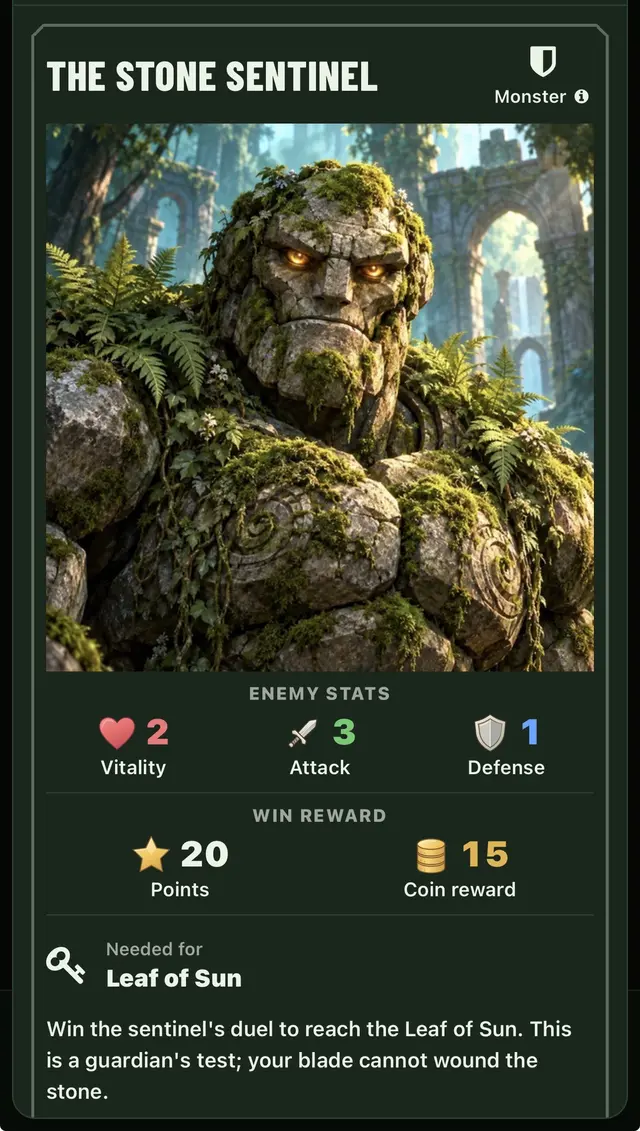
A real card, as a team's phone opens it: a monster, what a win pays and the card it guards. Your own cards ask about your exhibits.
Reading the labels is the trail
The card at the astrolabe asks what it measured. The phone does not say; the label does. The code hangs beside the object, so finding one is finding the other.
A boss in the last gallery
Teams fight the boss in a mini-game on the phone. Its card stays locked until the team has found the sword you wrote into your story, so nobody skips to the end.
Written around your rooms
You write the questions with the AI assistant you already use — about 30 minutes. Then walk the rooms once and check each answer against its label.
What it costs
- Try it first with a ready-made story: 10 minutes to pick, print and cut.
- Then write your own around your galleries: $1 a card, art included — 20 cards is $20 (20 Gold Eggs), once.
- A player is a team, not a child. Gold Eggs come in one-off packs — no subscription.
Test the basement gallery for signal before you mount a code there. Codes print on any printer.
Build a trail for freeWhat the day looks like
-
They arrive and split
The class splits into teams, each with a teacher's or a helper's phone. Joining is a scan and one tick of the terms box, so they are playing once the coats are off.
-
They work the rooms
Teams start at any code and fan out, so the whole class is never standing at the same case.
-
The leaderboard decides it
Points for right answers, treasure and beaten monsters. The leaderboard is live, so the last 10 minutes are a real finish, not a slow walk to the shop.
What education leads ask
Mount it once. Every class that books plays it.
Your staff do nothing on the day.
Your first 5 players are free, no card. Then $1 a player.