At the venue
The switches a host flips on the day, and the things that hold whatever is flipped: one story runs as a plain tour or a full RPG, as a race or at each team's own pace, for one afternoon or all season with the board clearing every night.
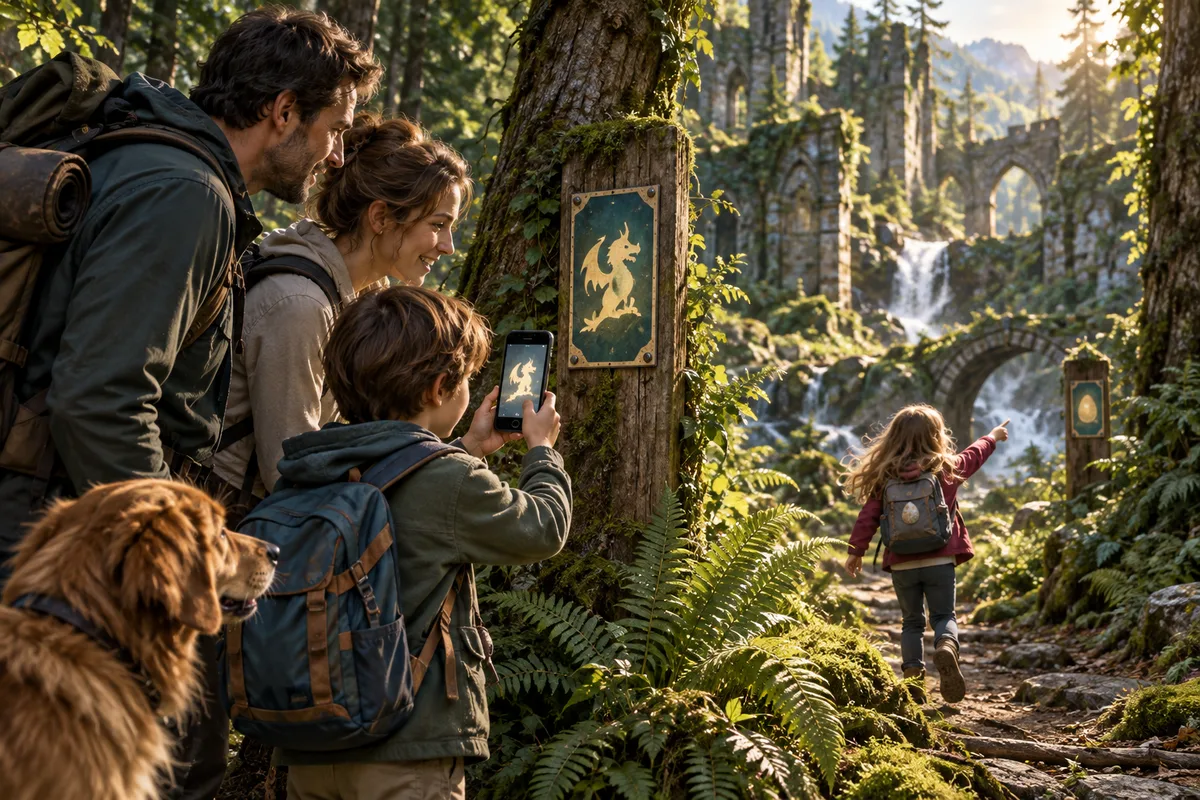
One switch, two games
A story carries one flag. Off, it is a plain QR hunt: scan, collect, answer, score. On, it is everything in this handbook. The switch is on the story, not the trail.
Basic mode
A plain QR scavenger hunt. Players scan codes, collect cards, answer questions and score points. No combat, no coins to spend, no gear. It is the right shape for a corridor of exhibits, a first visit, or a party of five-year-olds where the point is finding things.
Scan, collect, score.
RPG mode
Everything in basic mode, plus enemies fought through the duel, a coin economy with a merchant, traps that make you choose, allies who hand out gear, bosses locked behind the things you had to find first, and — if you want it — a marketplace the teams trade in.
Scan, fight, spend, unlock.
At the venue
The same venue can run a plain tour for a school group in the morning and a full RPG for a family afternoon — from two stories and two sets of codes.
The rule
- Basic mode uses five of the nine kinds and has no coins to spend; RPG mode turns on the other four and everything that reads a stat.
- The switch decides which kinds the card form offers, so a basic story cannot hold an enemy by accident.
You decide
- The flag on the story.
From the library
The library's five-year-old story is a full RPG; its youngest players fight a boss.
A race, or each team at its own pace
A race has one starting gun and one deadline for everybody, and pays the first-find bonus. A self-paced trail starts each team's clock when it arrives and pays no bonus.
At the venue
On a race the board has one clock and the whistle ends everyone's run; a team whose time is up can read the market and buy nothing. On a self-paced trail each team runs against its own deadline, and a family on Tuesday plays the same trail as a family on Saturday.
The rule
- A race is a trail marked synchronous; its deadline is the trail's. A self-paced trail's deadline is each team's own, counted from arrival.
- The first-find bonus is a race mechanic: on a self-paced trail "first" is only whoever came earliest, so nothing is paid.
- The nightly clear is for self-paced trails; a race is refused it.
You decide
- Whether the trail is a race, its length, and the bonus.
From the library
The demo trail is self-paced and clears nightly.
The daily ranking: the board clears every night
On a plan that allows recurring daily runs, set a ranking hour. At that hour, the badges are awarded, the finishing positions stamped, the day banked, and the day's teams cleared — in that order, all or nothing. Every card is back on the trail in the morning.
At the venue
A season venue's board is the day's. A team that finishes at four is on the board until the hour, takes its badges and its position, and is gone by morning; the account that played keeps its badges and its record of the day.
The rule
- The clear runs once a day, on the hour the host sets in the trail's own time zone, and never twice for one day.
- Badges first, then positions, then the day's record, then the purge — one transaction, so a day is never half-banked.
- The day's listings go with the day's teams, and every card's copies are back on the trail because the rows that held them are gone.
- A team's account keeps every badge it earned and the record of the day; the team row itself does not survive the clear.
You decide
- The hour, and the time zone it is counted in.
From the library
The demo trail clears at the default hour, so each day's board starts empty.
The plan sets the seats; the host sets the crowd the copies are cut for
Your plan sets how many teams play at once, and there is no fee per player. The number of players you expect is what every card's copies are cut from: the party size times the rarity's percentage, rounded up.
At the venue
A trail full to its seats tells the next walk-up it is full, and lets them watch. A card that has run out of copies says so; the nightly clear brings the copies back with the morning.
The rule
- The seat count is the plan's and holds on every trail — the board that clears nightly counts its seats per day.
- The copies of each card come from the players the host expects, not from the plan's seats, so a Rare card is rare at a party of eight on a fifty-seat plan.
- The automatic-join guard starts at 500 teams a day and grows to cover larger plans. A full hunt still stops at its plan’s player limit.
- Changing the expected players recuts the copies; changing the plan does not, on purpose.
You decide
- The plan, on the org; the expected players, on the trail.
From the library
The demo trail's copies are cut for the party its host named, like every trail's.
Badges outlive the trail
Four badges. Finisher, for finishing a trail. Top 10%, 5% and 1%, by finishing rank when the race is called or the day clears — the highest tier only, rounded so a small board's winner takes the top.
| Badge | How it is earned |
|---|---|
| Finisher | Finish a trail. Every trail you complete adds one. |
| Top 10% | Top 10% of the board when the race is called or the day clears |
| Top 5% | Top 5% of the board when the race is called or the day clears |
| Top 1% | Top 1% of the board when the race is called or the day clears |
At the venue
A trophy shelf on the account, with each badge counted as many times as it was earned. A guest team's badges go with the team when the board resets; an account keeps them.
The rule
- Finisher lands the moment a team completes the trail, once per trail per account.
- The percentile badges are handed out among teams that scored, ranked by points, then remaining coins, then elapsed playing time; the host is excluded.
- Thresholds round up, so on a board of eight the winner takes the top 1% alone.
- An award outlives its trail: delete the trail and the badge stays on the account.
You decide
- Nothing on the story — badges are the trail's to hand out. The art on each is the operator's.
From the library
The four badges ship seeded; their art is drawn once, by the operator, and worn by every trail.
Presence: a deterrent, not a boundary
A host can ask a phone to be within a radius of a pinned code — 10 to 1000 metres — before a capture counts. It is a deterrent against a photographed code, never a boundary: the position is whatever the browser posts.
At the venue
A code with presence on asks the phone where it is. Too far, and the card says so in tens of metres and never in a direction; no fix, and the card says that instead. A coarse fix gets the benefit of the doubt.
The rule
- Off by default, per trail, and only on a code the host has pinned on the map.
- The radius is between 10 and 1000 metres; a fix's accuracy is subtracted before the comparison, so a poor fix is forgiven rather than refused.
- Nothing is stored. The check gates the capture, not the card, and the host is exempt.
You decide
- The switch, the radius, and which codes are pinned.
From the library
The demo trail runs presence off; a code on a web page has no place to stand.
No app, no account, a team name
A phone camera opens the code in the browser. Joining costs a team name; a guest holds no email at all. The scanner in the browser reads the trail's own codes and nothing else.
At the venue
Point the camera at the code, tap the link, name the team, play. On a phone with no code reader the trail's own scanner opens the camera; on an iPhone it decodes in the page rather than waiting for a reader the browser does not have.
The rule
- A guest is a credential-free account with no email, and nothing at all is collected from a child.
- The in-page scanner accepts only this trail's codes — any other code is refused, never followed.
- A team name is refused, never rewritten, when it hits the blocklist, and a team gets one rename while it still carries its generated name.
You decide
- Nothing. This is the promise every trail keeps.
From the library
The demo deck's first code opens the same way a printed one does.
2 languages on the trail
The trail runs in English or Spanish. A story is written in one language and translated in place, card by card; a player reads the trail in their own language when the story speaks it, and in the trail's otherwise.
At the venue
The card, the board, the messages and the badges follow the player's language. A story translated into Spanish shows its Spanish cards to a Spanish reader and its English cards to everybody else.
The rule
- Translation re-words a card and never re-shapes it: which sections a card has is decided by the original, and the translation fills them.
- A question's options are translated against the same answers, so which one is correct cannot move.
- The playtest fails a story with an untranslated question or role in a language it claims to speak.
You decide
- The story's language, and the translations you write for it.
From the library
The demo deck is bilingual, every species real.
The honest limitation: phone signal where the codes hang
A phone needs to reach the site to open a card. Nothing else is needed — the stylesheets, the scanner and the games are served by us, never from a CDN — but a basement corner with no bars is a code that scans and then spins.
At the venue
Mount the codes where the signal reaches. A card opens over the network once and the game on it runs in the page; a card that will not open is a signal problem, not a code problem.
The rule
- No app to install and nothing to download ahead of time; a card loads when it is scanned.
- Everything the page needs comes from the site, so a venue that blocks third-party hosts still plays.
You decide
- Where the codes hang.
From the library
Every library story runs the same way — a hunt runs in a museum basement, which is why nothing comes from a CDN.
Run one this month.
- Free includes every ready-made story, printable codes and the leaderboard. No card, and it never expires.
- One trail at a time, and 3 teams on its board. A team is one phone, any number of people — and your own phone takes no place.
- A place frees when you press Reset the board. Finishing a hunt frees your trail slot for the next one.
- Paid plans add stories of your own and more daily players. Automatic daily resets start at 50 players. Upload your own card art.