The nine kinds of card
The kind decides what a scan does. You choose the name, art and rewards. Four of the nine are RPG-only; the others work in a basic hunt too.
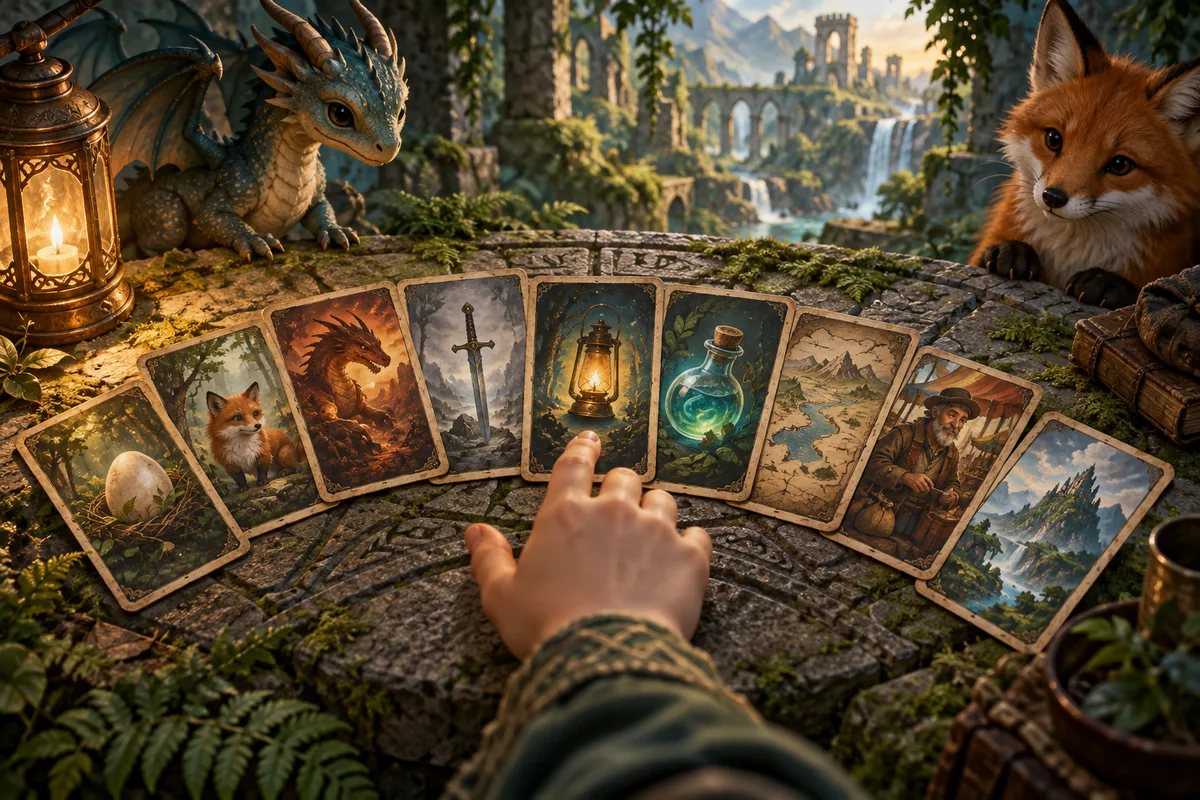
Collectable: treasure, found and banked
Scanning it banks its points, its coins and any stats it carries, and it is done. Pays its points and coins; never takes any.

At the venue
A scan opens the card face up. Collecting adds its points, coins and stats and marks it found. The story can make a creature a catch, or offer an optional timing bonus on a discovery. Skipping or missing timing still collects the card.
The rule
- Points, coins and stats — attack, defense, vitality — land the moment the card is found. The points are paid once per team, however many hands the card passes through afterwards.
- A collectable with a stat is gear: on a roles trail it takes a slot and pays in full or by half according to its tag, and it can be listed on the marketplace.
- The story builder chooses Catch, optional Timing, no challenge or the type default per collectable. Animal and Creature suggest Catch; Weapon suggests Timing. Enemies always duel.
You decide
- The points, the coins, and any of the three stats.
- The rarity, which sets how many copies are printed, and the type, which picks a skill game or none.
- Which cards it opens: name it in another card's lock and it becomes a quest key — free to carry, never for sale.
From the library
The demo deck's six gallery cards are collectables, and its boss requires all six.
Question: a quiz, and you write the options
Two options at least, exactly one right, shuffled per team. Right pays the card's points, coins and stats; wrong costs the card's coins and the card stands.

At the venue
The question and its options, in an order this team was dealt and keeps. A right answer lands the points and the coins; a wrong one costs coins, scores nothing and leaves the card where it was, so the team can think again.
The rule
- At least two options and exactly one correct — the playtest fails a question with neither.
- The options are shuffled for each team and stay in that order for it, so the right answer is never simply the first one.
- Right: the card's points and coins, the first-find bonus on a race, and any stats. Wrong: the card's coins, never below zero, no points, and another try.
- There is no typed answer. A typed lock accepts one spelling in one language, and its author never sees who failed it.
You decide
- The wrong options are the question: pick them from things a player could actually believe.
- The points, and the coins — which are also the price of a wrong answer — and any stats a right answer grants.
From the library
The demo deck asks which dinosaur had three horns, one gallery on from the Triceratops.
Checkpoint: a rest that banks progress
Pays its points and coins. In RPG mode it heals the team to the highest vitality it has earned; in basic mode it is a card that scores and marks the way.

At the venue
Somewhere safe — the tent halfway round the trail. A scan banks the card and, in RPG mode, a battered team's vitality climbs back to the most it has ever earned.
The rule
- Every deck opens on one: the Start card is a checkpoint, and the playtest fails a story without a Start.
- In RPG mode a checkpoint restores vitality to the team's earned ceiling — starting vitality plus what allies and gear have added — and never above it.
- It is the only healing a lost fight ever gets besides the bench: a knockout revives at half, a checkpoint at full.
- The playtest warns about an RPG story with no checkpoint after the Start.
You decide
- Where it sits. One before the boss is what makes a hard fight fair.
- Its points and coins, which it pays like any card.
From the library
The demo deck opens on The Burrow at Dawn, its Start card.
Dice roll: a gamble you opt into
Both sides roll four dice and add five. The higher total wins; a tie goes to the card. Win the pot and the card's points, or lose half the pot, rounded up — and walking away is a button.

Open the card to take a closer look.
From The Haunted Garden
At the venue
The card states the stakes before the roll. Roll, and both totals are read out; walk away, and the team keeps its purse and the card waits for later. Nobody is ever gambled at.
The rule
- Each side rolls four six-sided dice and adds five — a total between 9 and 29 — and the higher total wins. A tie is a loss.
- Win: the card's points and its full coins. Lose: half the coins, rounded up, never more than the purse holds, and no points.
- The card is banked either way — the roll is the only way to claim it.
- The odds favour the team: the same dice on both sides, a full pot for a win against half of it for a loss.
You decide
- The points, paid on a win only, and the coins — the pot, and half of it the price of losing.
From the library
The Dice Roll type ships seeded, and every story names its own gamble.
Event: a story beat, no stats
Banks the card and any points and coins it carries. No stats, no fight, no decision — its description is read as prose.

At the venue
The boss arrives. The tide comes in. The gardener tells you what he saw. The card reads as a page of the story rather than a rules note, and the team moves on.
The rule
- An event pays the points and coins its author put on it and nothing else; most carry none, so the board does not move.
- It is the one kind that needs no flavour text of its own — the description is the prose.
- Available in basic mode as well as RPG mode.
You decide
- The prose. An event card is how a trail gets a middle.
- Points and coins, if the beat should also score.
From the library
The demo deck's The Sky Falls is an event.
Enemy: a fight, always tapped out on the phone
Every enemy is fought through the duel. Win: its points and coins. Lose: vitality and coins, capped at a quarter of the purse, and no points. The card stands either way.

Open the card to take a closer look.
From Dinosaur Dig Adventure
At the venue
The stakes line, the enemy's numbers, the Fight button, then the arena — the one on the combat chapter, on a card. A team that loses walks back and fights it again.
The rule
- There is no stat comparison that skips the duel, and a custom enemy type fights it too. Gear tunes the fight; it never decides it.
- Three seeded types, one choreography each: Foot Soldier, Monster, Boss. A Boss ends the quest when it falls.
- An enemy pays its points and coins on a win and never its stats. On a loss it takes vitality and coins, and at zero vitality the team sits on the bench for a minute.
- RPG mode only.
You decide
- The points and the coins — what the fight is worth on the board and in the purse.
- Attack, defense and vitality — the whole of the duel's arithmetic.
- The type, which picks the choreography, and the cards it requires, which are what make a hard fight fair.
From the library
The demo deck's Tyrannosaurus rex is its Boss, gated behind six galleries.
Trap: a hazard with a decision in it
Disarm it on a coin flip — free if it works, the full price if it fails — or step around it for half the price, rounded up. Coins only, never stats, and both routes bank the card and any points on it.

At the venue
Two buttons, both priced before the tap: disarm, or step around. A purse that cannot pay the full toll sees the toll drop to what it can lose. Either way the card is banked and the trail goes on.
The rule
- Disarm: a coin flip. Heads, it costs nothing; tails, the card's full coin value.
- Step around: half the card's coins, rounded up, guaranteed.
- A trap takes coins only — never attack, defense or vitality — and never more than the purse holds. Any points on the card are paid either way; most traps carry none.
- RPG mode only.
You decide
- The coins, which are the price. A known half against an even chance at nothing is the whole design; how much the team has to lose decides it.
From the library
The Trap type ships seeded and RPG-only; every story prices its own tar pit.
Merchant: a shop, and you stock the shelf
Finding the merchant opens its shelf. Each ware costs its own coin value and grants its stats, never points; the stock never prints on the sheet or the board.

Open the card to take a closer look.
From Dinosaur Dig Adventure
At the venue
A scan opens the shop: every ware with its price and what it grants, a Buy button on each the purse can afford, and the team's coins counted at the top. Buying spends the coins and hands over the card on the spot.
The rule
- A ware is any card pointed at the merchant. It is revealed at the shop and hidden nowhere — it is a shelf, not a hiding place.
- The price is the ware's own coin value, checked again at the purchase; there is no haggling and no skill game.
- A bought ware scores nothing. Points are for what a team finds, answers and beats, never for what it buys.
- A ware with a lock of its own stays locked on the shelf until its cards are found.
- The merchant card itself pays nothing unless its author put points on it; finding it is the gate. RPG mode only.
You decide
- Which cards point at the merchant, and what each costs. Stock the shelf with the gear that makes the boss winnable and you have built a decision, not a shop.
From the library
A silver spade behind a night gardener is often the thing that unlocks the boss.
Ally: a friend who hands you something
Pays its points, its coins and its stats — attack, defense or vitality — and takes nothing. No fight, no cost, no decision.

At the venue
A scan, a face, a gift: the ally's stats land on the team's numbers and the story moves on. The kind way to arm a team before you ask it to fight.
The rule
- An ally grants points, coins and stats the moment it is found, like a collectable that happens to be a person.
- It is gear: on a roles trail it takes a slot and pays by its tag, and it can be listed on the marketplace.
- Two allies early is how a story makes its own boss winnable without softening it. RPG mode only.
You decide
- Which stat it hands over, and how much. Vitality is the one a checkpoint will later heal back to.
- Where it sits: before the fight it is armour for, or behind a lock of its own.
From the library
The team the arenas fight as carries what two allies and a weapon hand over.
Kinds and types: eighteen ship, and you can add your own
A kind is the mechanic; a type is a named version of it with its own glyph and default picture. Eighteen types ship across the nine kinds, and a type you add keeps its kind's rules.
| Type | Kind | Configured game |
|---|---|---|
| Ally | Ally | No game |
| Checkpoint | Checkpoint | No game |
| Start | Checkpoint | No game |
| Animal | Collectable | No game |
| Character | Collectable | No game |
| Creature | Collectable | No game |
| Item | Collectable | No game |
| Purchase | Collectable | No game |
| Treasure | Collectable | No game |
| Weapon | Collectable | The timing bar |
| Dice Roll | Dice Roll | No game |
| Boss | Enemy | The duel |
| Foot Soldier | Enemy | The duel |
| Monster | Enemy | The duel |
| Event | Event | No game |
| Merchant | Merchant | No game |
| Question | Question | No game |
| Trap | Trap | No game |
At the venue
A card wears its type's name on its band and its type's picture until it has art of its own. Foot Soldier, Monster and Boss are all the enemy kind, with different names, different art and — for the duel — different choreography. The table shows each type's current game configuration, which can differ from the defaults.
The rule
- Eighteen types ship: Start, Item, Animal, Character, Creature, Question, Dice Roll, Checkpoint, Event, Ally, Foot Soldier, Monster, Boss, Trap, Merchant, Purchase, Treasure and Weapon.
- The story builder chooses Catch, optional Timing, no challenge or the type default per collectable. Animal and Creature suggest Catch; Weapon suggests Timing. Enemies always duel.
- A type you add keeps every rule of its kind — a custom enemy still fights the duel, so the retired stat-check combat cannot come back through the side door.
You decide
- Which type each card wears, and any type of your own — a name, a kind, a glyph, a picture.
From the library
Most of the library's stories use four or five of the nine kinds; none needs all eighteen types.
Rarity: how many of a card exist
Six tiers. A tier's availability sets how many copies of the card are printed — the party size times the percentage, rounded up — and half of a skill game's difficulty. It never changes points.
| Rarity | Availability | Copies for a party of 8 |
|---|---|---|
| Common | 100% | 8 |
| Uncommon | 75% | 6 |
| Rare | 50% | 4 |
| Epic | 25% | 2 |
| Legendary | 10% | 1 |
| Unique | 1% | 1 |
At the venue
The frame and the gem on the card say the tier; the printed sheet carries as many copies as the tier allows for the party the host named. With the chase selected, a rarer Animal is a smaller, faster target.
The rule
- Copies printed: the party size times the tier's availability, rounded up. A Unique is one code in the whole venue; a Common is one per team.
- Rarity moves no points and no coins — a Legendary treasure is worth exactly the coins written on it.
- Half of a skill game's difficulty comes from rarity; the other half from the card's attack and defense.
- The analysis warns when a prerequisite has fewer copies than teams, on any route. An availability of 100% supplies everyone. Scarce treasure that opens nothing is a valid choice.
You decide
- The tier on each card, and the number of players the trail expects — the copies are cut from that, not from the plan's seats.
From the library
The six seeded tiers run from Common, one per team, to Unique, one in the venue.
Basic mode: five of the nine
A basic-mode story uses collectables, questions, checkpoints, dice rolls and events. Enemies, traps, merchants and allies exist only in RPG mode — and the switch is on the story.
Basic mode
- Collectable
- Question
- Checkpoint
- Dice roll
- Event
RPG mode only
- Enemy
- Trap
- Merchant
- Ally
At the venue
Scan, collect, answer, score. No fights, no coins to spend, no gear — the right shape for a corridor of exhibits, a first visit, or a party of five-year-olds where the point is finding things.
The rule
- The story's RPG switch decides the kinds its cards may use, and the card form offers only those.
- The same venue can run a plain tour for a school group in the morning and a full RPG for a family afternoon, from two stories and two sets of codes.
- Basic mode ranks by points too; coins break a tie, followed by elapsed playing time.
- Find the core cards to finish: cards available to every team and cards needed to open others. Scarce optional treasure still scores. If the whole deck is scarce, collect-all remains the goal.
You decide
- The one switch, on the story. Everything the other chapters describe is what it turns on.
From the library
The library's five-year-old story, The Great Cake Rescue, is a full RPG ending on a boss — age is not what decides the switch.
Run one this month.
- Free includes every ready-made story, printable codes and the leaderboard. No card, and it never expires.
- One trail at a time, and 3 teams on its board. A team is one phone, any number of people — and your own phone takes no place.
- A place frees when you press Reset the board. Finishing a hunt frees your trail slot for the next one.
- Paid plans add stories of your own and more daily players. Automatic daily resets start at 50 players. Upload your own card art.