Nine kinds of card. Three skill games.
One switch turns them on.
Most QR hunts are a list of codes and a running total. Scan, read, walk on. This one has a fight in it, a shop to spend in, and a boss you cannot reach until you have found the right two cards. Same codes, same printed sheet — a card is played rather than read.
Free — one trail, 10 players, no card.
- 9 card kinds
- 3 skill games
- Quest gating
- Balance checked before you print
Why the depth is the point
A scan that is only a scan is over in two seconds. Every mechanic below exists to make the next two minutes worth walking for.
A card is played, not read
A fight is fought with a thumb. A weapon is earned on a timing bar. An animal is caught before it gets away. The phone stops being a page the player is reading and becomes the thing they are doing, which is the whole difference between a checklist and a game.
Decisions, not just discoveries
Disarm the trap or pay to step around it. Spend the coins on the lantern or keep them and stay top of the board. Take the dice or walk away. A route with choices in it is a route two teams describe differently afterwards.
The same codes carry a second visit
A hunt where every card is treasure is the same hunt the second time. Gating, a shop and a boss give a returning family somewhere they did not get to last time — and the codes on the wall never move.
One switch, two games
A story carries a flag. Everything below is what it turns on.
Basic mode
A plain QR scavenger hunt. Players scan codes, collect cards, answer questions and score points. No combat, no coins to spend, no gear. It is the right shape for a corridor of exhibits, a first visit, or a party of five-year-olds where the point is finding things.
Scan, collect, score.
RPG mode
Everything in basic mode, plus enemies fought through a duel, a coin economy with a merchant, traps that make you choose, dice you can walk away from, allies who hand out gear, bosses locked behind the things you had to find first, and — if you want it — a marketplace the teams trade in.
Scan, fight, spend, unlock.
The switch is on the story, not the trail — so the same venue can run a plain tour for a school group in the morning and a full RPG for a family afternoon, from two stories and two sets of codes.
The nine kinds of card
Every card in a story is one of these nine. The kind decides what a scan does; the name and the artwork are yours. Four of the nine are RPG-only.
Collectable
Treasure. Found, pocketed, scored.
The card the whole hunt is made of. Scanning it banks its coins and any stats it carries, and it is done. Some collectables are skill-gated — a Weapon has to be wielded on the timing bar, an Animal caught before it scurries off — but a fumbled attempt on one of those costs nothing at all.
Pays its coins. Never takes any.
Question
A quiz. You write the answers.
Multiple choice, with the options shuffled — the correct answer used to always come first, which children work out faster than adults do. Two options at least, exactly one of them right. The wrong options are the question: pick them from things the player could actually believe, and the card asks something. There is no typed answer, because a typed lock accepts one spelling in one language and its author never sees who failed it.
Right answer pays. Wrong one costs coins and leaves the card standing — they can think again.
Checkpoint
A rest stop that banks progress.
Somewhere safe. In RPG mode it restores a team's vitality to the highest they have earned, which is what stops a lost fight being permanent — the tent halfway round the trail. In basic mode it is simply a card that scores and marks the halfway point.
Pays its coins. Heals back to earned vitality.
Dice roll
A gamble you opt into.
Two dice against the card's two. The card states the stakes before the roll, and walking away is a button rather than a trick — a player who does not want the risk keeps their purse and their afternoon. Nobody is ever gambled at.
Win and take the pot. Lose and pay half of it.
Event
A story beat, no stats.
The boss arrives. The tide comes in. The gardener tells you what he saw. Nothing moves on the scoreboard, which is exactly the point: an event card is how a trail gets a middle. Its description is read as prose rather than as a rules note, because a card with no rules to explain has nothing else to say.
Scores nothing. Changes the story.
Enemy
A fight, always tapped out on the phone.
Every fight resolves through the duel. There is no stat comparison that skips it and there never will be again — gear tunes the fight, it does not decide it, so a well-equipped team has an easier duel rather than no duel. Losing is real: vitality and coins. The card is not consumed, so a beaten team can come back and try it again.
Win: the card's coins. Lose: vitality, and coins capped at a quarter of the purse.
Trap
A hazard with a decision in it.
Two ways past, and the player picks. Disarm it — a coin flip, and a clean disarm costs nothing while a fumble costs the full price. Or step around it for half the cost, guaranteed. That is the whole design: a known price against an even chance at nothing, decided by how much the team has to lose.
Costs coins either way. Both routes bank the card.
Merchant
A shop. You stock the shelf.
The reason coins are worth having. You choose exactly what a merchant sells by pointing other cards at it, and that stock never goes on the printed sheet and is never hidden anywhere — it is revealed at the shop, which is what a shop is. A silver spade behind a night gardener is often the thing that unlocks the boss.
Takes coins. Hands over cards and stats.
Ally
A friend who hands you something.
The kind way to arm a team before you ask them to fight. An ally card gives attack, defense or vitality and sends them on — no fight, no cost, no decision. Two allies early is how a story makes its own boss winnable without softening it.
Pays its coins and its stats. Takes nothing.
A kind is the mechanic; a card type is a named version of it. Foot Soldier, Monster and Boss are all the enemy kind with different names, different artwork and — for the duel — different choreography. Eighteen types ship; you can add your own.
The three skill games
Some cards are not handed over for scanning them. They are played for, in the browser, with a thumb.
The duel
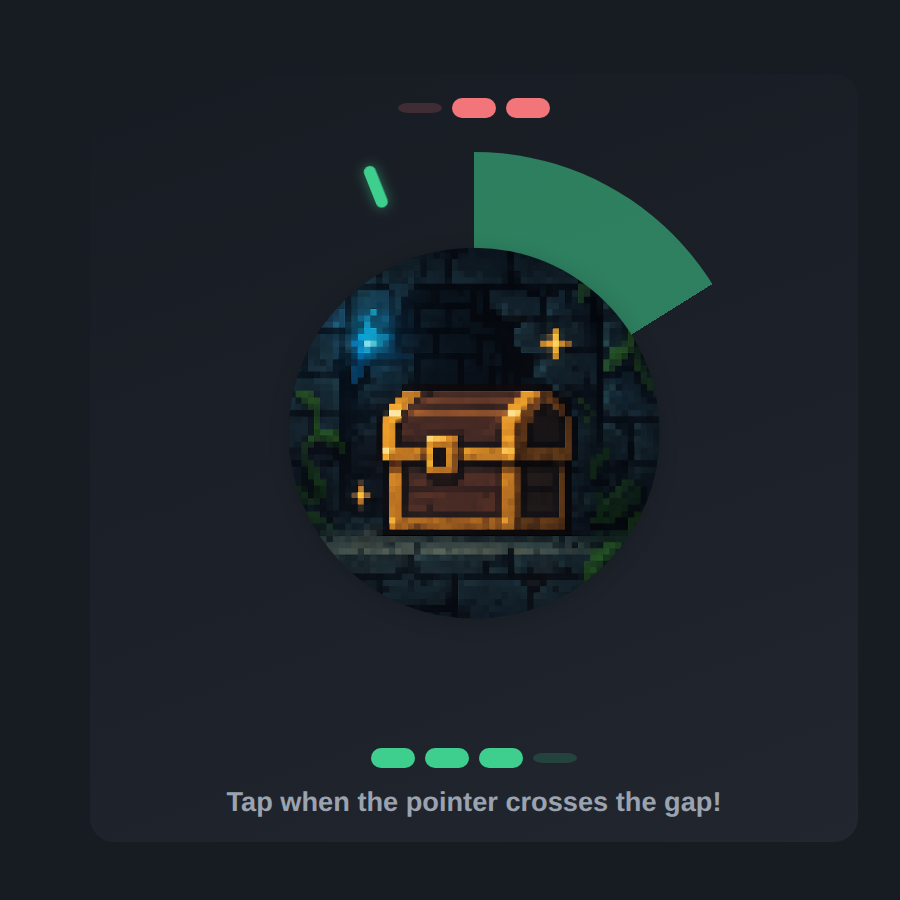
A pointer sweeps around the enemy. There is a gap in its guard. Tap when the pointer crosses the gap and you land a hit; tap anywhere else and you lose a blow of your own guard. Land enough hits and the fight is yours. Run out of guard and it is not.
Four numbers come off the two cards' stats and nothing else: how many clean hits the enemy takes, how many misses your team can afford, how wide the gap is, and how fast the sweep runs. A bigger sword makes the fight shorter, not skippable.
- Used by
- Every enemy card
- Stakes
- Real. Vitality and coins.
The chase
The card drifts across the stage and changes heading at random, so it cannot be led. Tap it before the clock runs out. A rarer, tougher card is smaller, faster and gives you less time.
For the cards a story wants to feel alive — a ladybug, a peacock, something that would obviously run. A missed catch just resets.
- Used by
- Animal and Creature cards
- Stakes
- None. Retry as often as you like.
The timing bar
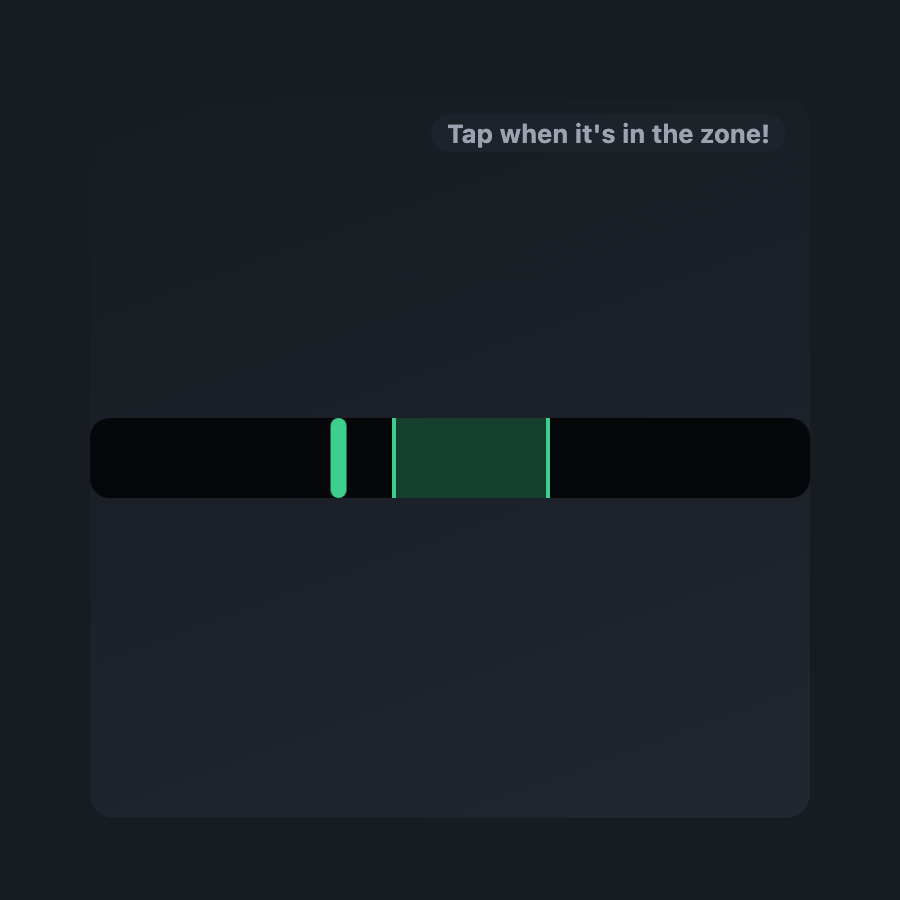
A marker sweeps along a track. Tap it inside the green zone to claim the card. Miss, and the zone jumps somewhere else — so the second attempt has to be read rather than remembered.
Weapon training. It is a skill gate on an ordinary pickup, not a fight, which is why missing it costs nothing but the two seconds.
- Used by
- Weapon cards
- Stakes
- None. Retry as often as you like.
Only one of the three has stakes. A missed fight costs vitality and coins; a missed catch or a mistimed strike is retried in the browser with no round trip to the server and no penalty at all — fumbling a tap on a treasure has to stay friendly for a seven-year-old.
Inside the duel
The one mechanic worth reading the arithmetic of, because it is where a trail is won, lost or ruined.
Combat used to be a stat comparison: bring a big enough sword and the enemy fell over with nothing to play. That path is retired and cannot come back — a custom enemy type an author invents still fights through the duel. What the stats do now is tune it.
What the stats decide
Hits to win
From the enemy's defense and vitality, less your attack. An enemy's vitality is its health — it is what makes a boss a boss.
Guard you carry
From your defense and vitality, less the enemy's attack. This is how many mistimed taps the fight forgives.
The gap
From the enemy's defense. A well-armoured enemy leaves a narrower opening to aim at.
Sweep
From the enemy's attack. A fast enemy comes round faster, which leaves less time to read it.
Three tiers fight three ways
Choreography, never arithmetic — the numbers above are identical across all three. A patient tap lands in every one of them; what changes is what you are watching.
Foot Soldier
One steady sweep. Every custom enemy type fights this pattern too.
Monster
The sweep turns around every time you land a hit, so the next opening has to be re-read rather than assumed.
Boss
At half health it rages: the gap telegraphs and then relocates, once a round.
What losing costs
Vitality
The enemy's attack less your defense, never below zero. Armour genuinely protects.
Coins
The card's value, capped at a quarter of what the team is carrying. A seeded boss is worth 42–54% of a story's coins, and uncapped one lost fight erased a child's whole afternoon.
60 seconds
At zero vitality the team is knocked out for a minute, then revives at half the vitality they had earned. Not a game over — a sit-down.
The card states the price of losing before the fight, and quotes the same method that charges it — so a card can never over-promise what a loss will cost.
Gating is how a story gets a shape
Any card can be locked behind other cards. That single rule is what turns a pile of hiding places into a quest.
Requires
A card can name the cards that must be collected before it opens. The boss needs the lantern and the silver spade; until both are found, scanning the boss says so. This is the only structure a trail has, and it does the work of a plot.
Opens
The same fact read backwards, and it is printed on the card. Without it a prerequisite is indistinguishable from ordinary loot — a player pockets the brush, forgets it, and hits a wall twenty minutes later with no idea what they are missing.
Deck position
Cards carry their place in the deck and print it — "Card 7 of 18" — so a team knows how much trail is left. On a self-paced trail that is the difference between finishing and drifting to the car park.
Beating the boss ends the quest, not the hunt. Every card still out there keeps scanning and keeps scoring afterwards — a finisher with seven codes still hidden gets their stats and the count of what is left, not a victory banner over a party with an hour to run.
The economy
Coins are the score and the currency at the same time, which is what gives a spending decision teeth.
Coins are the leaderboard
Teams are ranked on coins, with time spent as the tiebreak. So every coin handed to a merchant is a place on the board given up for whatever it buys.
The merchant is the sink
The one place coins go by choice. Stock it with the gear that makes the boss winnable and you have built a decision rather than a shop.
First find pays double
On a live race, the first team to reach a code takes a bonus nobody else can. It is off on a self-paced trail, where teams arrive on different days and the race would be won by whoever came first on the Saturday.
Rarity sets how many exist
Six tiers, and the tier decides how many copies of a card are printed relative to the number of players. A Legendary is one code in a venue; a Common is one per team.
The marketplace
Every other mechanic on this page is a team against the story. This is the one where the other teams are the content.
Turn it on and a team can sell a card it captured to any other team on the trail, at a price it names. What changes hands is more interesting than the card: coins are the leaderboard, so a buyer pays in rank for the stats, and a seller hands over the gear to climb. Both teams can be right about that, which is what makes it a decision rather than a shop.
Three ways a card moves
List one of yours
A Collectable or an Ally your team captured goes on the shelf at any price from one coin up. It stays yours while it sits there — your loot, your stats, your quest gates — and you can take it back off at any time. Nothing is committed until somebody buys it.
Buy from another team
The shelf names the card, the price and the team selling it. Buying moves your coins to them and the card to you, with the attack and defense on it. You cannot buy your own listing, or a card your team already holds. If two teams tap Buy in the same second, one gets it and the other is told it is gone — never both.
Or the trail is the shop
Mark a card as market stock and the trail sells it itself, at its coin value, with no Merchant card to find first. It stays off the printed sheet like merchant stock — a shelf rather than a hiding place. Quest gates still hold: a card locked behind two finds is not for sale until they are found.
The rules that keep the board honest
Quest items never sell
A card that unlocks another card is refused by the shelf, and the sell form never offers it. Selling it would re-lock the seller's own quest and hand the buyer a boss they never found the key to. Both halves are real, so the key stays with the team that walked to it.
Coins move, and are never made
A sale takes coins out of one purse and puts them in another. Nothing is minted, so a trail with trading on adds up to exactly the same total as the same trail with it off.
Trading moves the ceiling; checkpoints do the healing
Attack and defense go with the card. Health does not: a resold card raises what the buyer may carry rather than healing them on the spot, because its health was already paid out once to whoever found it — and paying it again on every hand-off is how two teams would farm it. The trail's own shelf still pays in full, because that is a first find rather than a resale. No team can sell itself unconscious: what you may carry is three plus the cards you hold, so it never falls below three.
The clock closes the shelf
On a countdown trail, a team whose time is up can read the market and buy nothing, and their listings come off it. A run that has ended must not go on earning, and a finished team must not be paid after the whistle.
The marketplace belongs to the story: switch it on there and every trail built from it opens with one. A host can still close theirs, so one story runs twice from the same cards and the same printed sheet — trading on for the family afternoon, off for the school group. It needs RPG mode, because basic mode has coins and nothing to spend them on. It is off until an author asks for it.
It is playtested before you print it
A scavenger hunt fails quietly: nobody complains, they just stop halfway. So the story is graded before there is a sheet of codes to hide.
Every fight is fought
The audit runs each enemy against the gear its own gates guarantee a player will be carrying, through the engine's own arithmetic rather than a second copy of it. A fight that needs two more clean hits than it forgives misses is a fight most diligent players lose, and it fails the check.
Age decides two numbers
How hard an ungated enemy may hit — 2 under six, 3 at six and seven, 4 from eight. Measured off the stories in the public library rather than invented. Deck size and gate depth do not move with age: the five-year-old story runs fifteen cards and gates three deep.
Dead ends and orphans
A boss nobody can reach, a merchant selling nothing, a prerequisite that is never hidden anywhere, a card no player can afford. The audit walks the story with a purse and reports what it could not do.
Three fights in the shipped library failed this check when it was written — Circe, the Sirens and Scylla, all in The Odyssey, all winnable less than half the time by a careful player. All three are gated behind a weapon or a piece of armour now.
Questions about the engine
Read a story that uses all of it
Nine ready-made adventures in the public library, free to browse and free to run.
Read the ready-made stories Write to us